We’d love for you to adopt a film! Adopting a film means that you–and your students, if you’re doing this as a teaching exercise–select a film and do research on it for materials to add to the film’s entry on SHEAF. Collate all of your info in a Word document as you go. Here’s a guide to help you along.
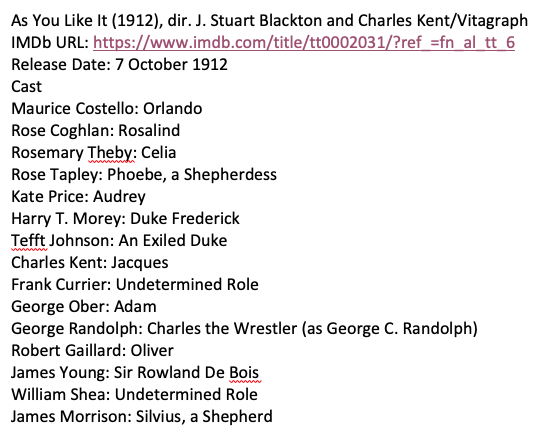
1. Pick a film. For this example, we’re using the 1912 As You Like It directed by J. Stuart Blackton and Charles Kent for Vitagraph. You can select any film, but our Top Five that we’d like to get on the site are:
Hamlet (1907), dir. Georges Méliès/Méliès
Macbeth (1908), dir. William V. (“Billy”) Ranous/Vitagraph
The Merchant of Venice (1914), dir. Phillips Smalley and Lois Weber
Richard III (1912), dir. André Calmettes and James Keane/Shakespeare Film Company
Romeo and Juliet (1911), dir. Barry O’Neil/Thanhouser
2. Go to IMDb.com and search for your film. Because there are so many Shakespeare films, you’ll need to check for the date and director. Once you’re on the IMDb page for your adopted film, put the page’s URL on your Word doc. We’ll link to the page from SHEAF.

3. Collect all of the basic information about your film, including release date, and cast.
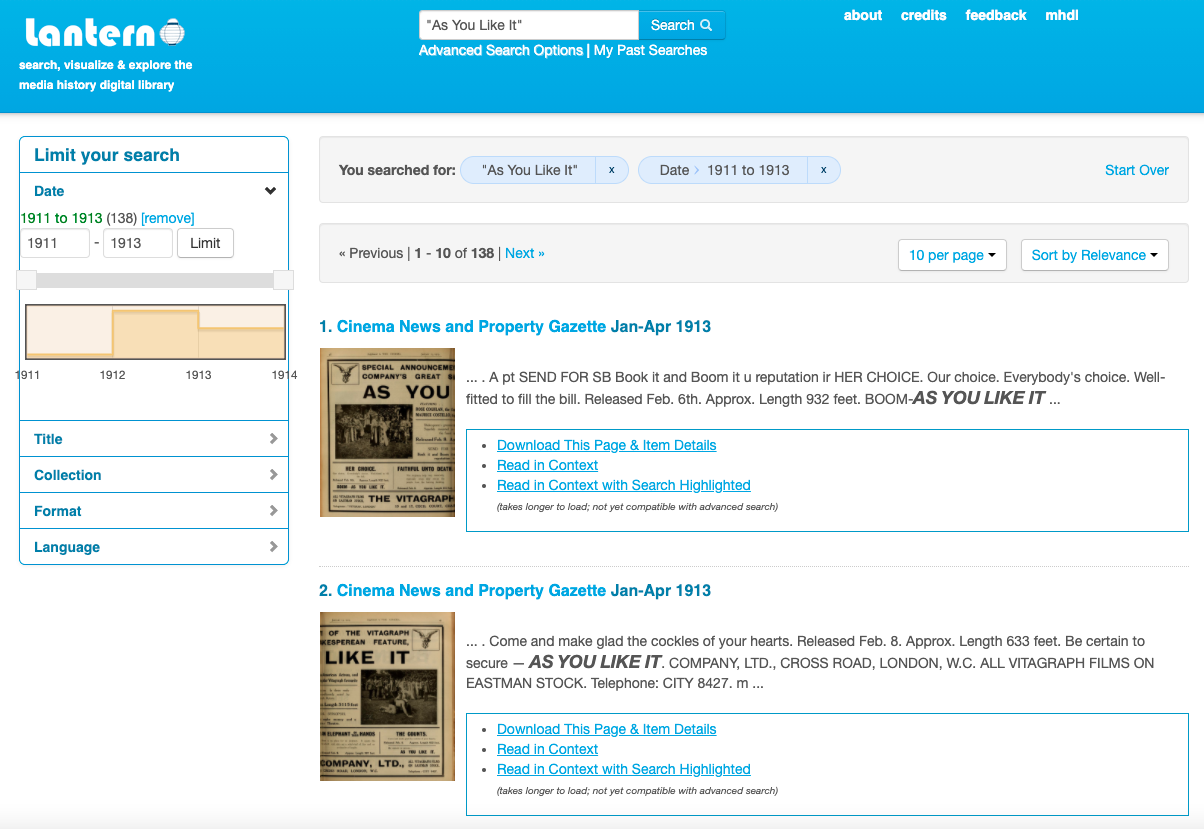
4. Research your film. We recommend using the Media History Digital Library, Chronicling America, readex, and, if it’s available to you, newspapers.com.
You’ll want to search by film title, by the directors’ and actors’ names, and by the studio name. Limit your search chronologically to the year before your film and the year after. Sometimes films of the same name were released close together, so make sure you’ve got the right one. Focus on finding reviews of the films, interviews with the directors and stars, and prominent advertising. A search for the 1912 As You Like It on the Media History Digital Library turned up a two-page advertisement followed by synopses and a review.
The review:
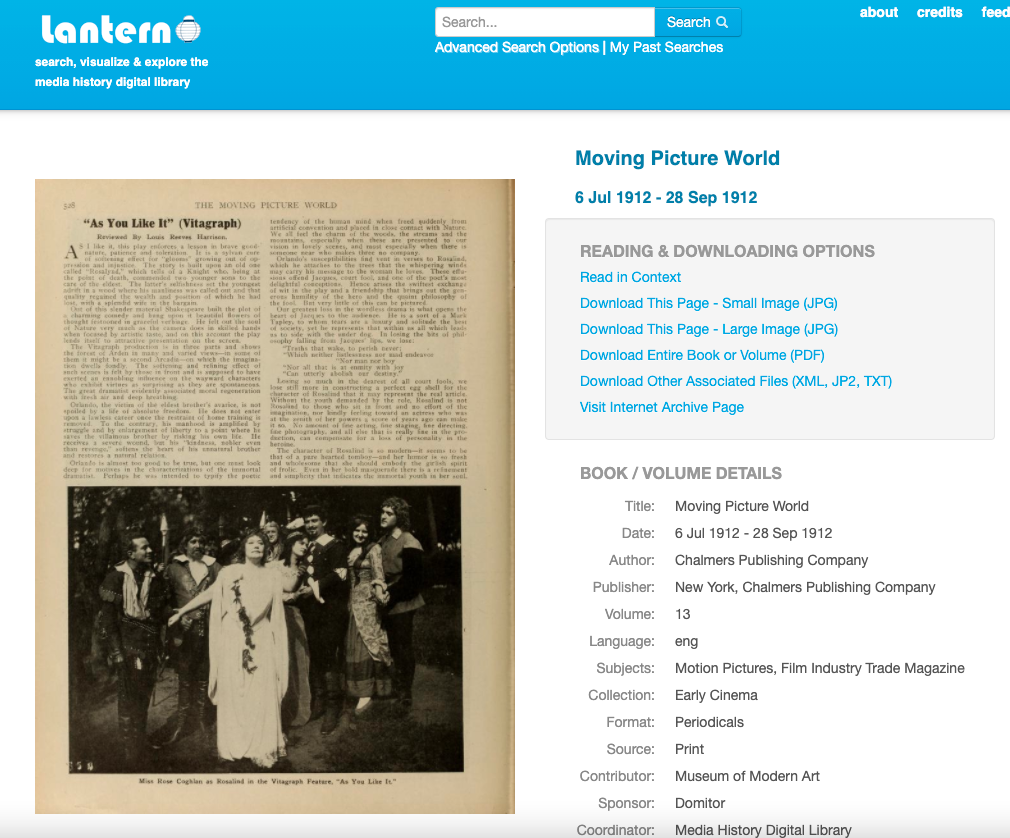
You can get an OCR transcription by clicking on “Visit Internet Archive Page” and selecting the “Full Text” option. Make sure to include the bibliographic data–you may need to go back several pages from the page with the search result to see what the issue date is; this review is from Moving Picture World, August 10, 1912 (vol. 13, no. 6): 528.
In the article has accompanying images, let us know in your Word doc. In your Word document, copy and paste the text from each article along with a URL for it. We’ll post the text and a link to it. Here’s the transcript from the full text with line breaks cleaned up.
“As You Like It” (Vitagraph)
Reviewed By Louis Reeves Harrison.
As I like it, this play enforces a lesson in brave good-nature, patience and toleration. It is a sylvan cure of softening effect for ‘”glooms” growing out of oppression and injustice. The story is built upon an old one called “Rosalynd,” which tells of a Knight who, being at the point of death, commended two younger sons to the care of the eldest. The latter’s selfishness set the youngest adrift in a wood where his manliness was called out and that quality regained the wealth and position of which he had lost, with a splendid wife in the bargain.
Out of this slender material Shakespeare built the plot of a charming comedy and hung upon it beautiful flowers of thought festooned in graceful verbiage. He felt out the soul of Nature very much as the camera does in skilled hands when focused by artistic taste, and on this account the play lends itself to attractive presentation on the screen.
The Vitagraph production is in three parts and shows the forest of Arden in many and varied views — in some of them it might be a second Arcadia — on which the imagination dwells fondly. The softening and refining effect of such scenes is felt by those in front and is supposed to have exerted an ennobling influence on the wayward characters who exhibit virtues as surprising as they are spontaneous. The great dramatist evidently associated moral regeneration with fresh air and deep breathing.
Orlando, the victim of the eldest brother’s avarice, is not spoiled by a life of absolute freedom. He does not enter upon a lawless career once the restraint of home training is
removed. To the contrary, his manhood is amplified by struggle and by enlargement of liberty to a point where he saves the villainous brother by risking his own life. He receives a severe wound, but his “kindness, nobler even than revenge,” softens the heart of his unnatural brother and restores a natural relation.
Orlando is almost too good to be true, but one must look deep for motives in the characterizations of the immortal dramatist. Perhaps he was intended to typify the poetic tendency of the human mind when freed suddenly from artificial convention and placed in close contact with Nature. We all feel the charm of the woods, the streams and the mountains, especially when these are presented to our vision in lovely scenes, and most especially when there is someone near who makes three no company.
Orlando’s susceptibilities find vent in verses to Rosalind, which he attaches to the trees that the whispering winds may carry his message to the woman he loves. These effusions offend Jacques, court fool, and one of the poet’s most delightful conceptions. Hence arises the swiftest exchange of wit in the play and a friendship that brings out the generous humility of the hero and the quaint philosophy of the fool. But very little of this can be pictured.
Our greatest loss in the wordless drama is what opens the heart of Jacques to the audience. He is a sort of a Mark Tapley, to whom tears are a luxury and solitude the best of society, yet he represents that within us all which lead-us to side with the under dog. In losing the bits of philosophy falling from Jacques’ lips, we lose:
“Truths that wake, to perish never;
“Which neither listlessness nor mad endeavor
“Nor man nor boy
“Nor all that is at enmity with joy
“Can utterly abolish our destiny.”
Losing so much in the dearest of all court fools, we lose still more in constructing a perfect egg shell for the character of Rosalind that it may represent the real article.
Without the youth demanded by the role, Rosalind is not Rosalind to those who sit in front and no effort of the imagination, nor kindly feeling toward an actress who was at the zenith of her powers a score of years ago can make it so. No amount of fine acting, fine staging, fine directing, fine photography, and all else that is really fine in the production, can compensate for a loss of personality in the heroine.
The character of Rosalind is so modern — it seems to be that of a pure hearted tomboy — and her humor is so fresh and wholesome that she should embody the girlish spirit of frolic. Even in her bold masquerade there is a refinement and simplicity that indicates the immortal youth in her soul.
She is a lively and good-natured girl who has her frolic as youth has its fling.
The whole play is a vacation. We leave the city with its graft, its police scandals, its envy, its wretchedness, and go to play in the woods, where the vagaries of society and the
vexations of domesticity are forgotten amid the simple joys of camping out. The screen presentation maintains this atmosphere as one on the stage might not do — we almost breathe the fragrance of the Forest of Arden. We feel
“The Power, the Beauty, and the Majesty
‘That have their haunts in dale or piney mount
Or forest by slow streams, or pebbly spring,”
And you who watch closely may learn that
“One impulse from a vernal wood
May teach you more of man,
Of moral evil, and of good
Than all the ages can.”
The part of Jacques is admirably portrayed, and many of the minor roles flash forth with star-like brilliancy at moments, adding value to the splendid ensembles.
The settings will startle many who have seen the stage
version and the whole production shows the incalculable advantages moving pictures have in the matter of background over legitimate productions. The types, with one exception, indicate clearly that some master minds and hands have been at work, and the acting straight through is commendable in a very high degree.
The impressionist critic must feel the warmth of the out-
door, Corot-like views of Nature.
“Who never did betray
The heart that loved her; for she can inform
The mind that is within us, so impress
With quietude and beauty, and so feed
With lofty thoughts, that neither evil tongues,
Rash judgments, nor the sneers of selfish men,
Nor greetings where no kindness is, nor all
The dreary intercourse of daily life
Shall e’er prevail against us, or disturb
Our cheerful faith, that all which we behold
Is full of blessings.”
5. Know when to stop. You don’t need to find every single instance of a film in the media, but try to find the articles that help provide an idea of what the film looked like, how it was staged, what was cut from the play to make the film, and similar topics. If you’ve found a couple of photos and a review or synopsis or two, that’s great! Some films won’t have a lot of photos, or will have tons of ads but no reviews, and that’s all fine–just capture and document what you think will be useful to other SHEAF users.
6. Send it in! Email your Word doc to Kendra Leonard, SHEAF founder and manager, at kendraleonard at pm dot me. Make sure you list your name and those of everyone involved in researching your film so that we can list you in the credits.
THANK YOU!
